

If you've ever tried to read the Income Tax Ordinance 2001 directly, you'll know the problem isn't that it's boring. It's that it was written by lawyers, for lawyers, and reads like it. Ask most business owners in Pakistan what's actually inside it, and you'll get a shrug. Yet this single piece of legislation decides how much tax you pay, when you pay it, and what happens if you get it wrong, whether you're a salaried employee, a shopkeeper, or running a private limited company.
This guide walks through what the Ordinance actually contains, structured the way it's structured, but written the way a person actually talks.
Why one law governs almost everything FBR does
The Income Tax Ordinance 2001 is the parent law behind Pakistan's entire income tax system. Every FBR notice, every withholding tax deduction on your salary, every SRO you've seen mentioned in a news article, all of it exists because this Ordinance gives FBR the legal authority to do it. Finance Acts passed each year don't replace it. They amend it, section by section, which is why the Ordinance you'd download today looks nothing like the one passed in 2001, even though the title hasn't changed.
Understanding its broad shape makes every other tax conversation easier, because almost everything FBR tells you traces back to a specific chapter here.
Chapter I, the definitions nobody reads until they need to
The Ordinance opens with definitions: what counts as a "person," a "resident," an "associate," and dozens of other terms used everywhere else in the law. This chapter also states, plainly, that this Ordinance overrides other laws where they conflict on tax matters.
Nobody reads this chapter for fun. People read it urgently, usually when a dispute hinges on whether they technically qualify as a "resident" or whether a particular payment counts as "income" under the Ordinance's own definition rather than the everyday one.
Chapter II, where the actual tax gets charged
This is the chapter that does the charging. It imposes the basic tax on your taxable income, and then layers on a handful of separate, specific taxes: on dividends, on a company's undistributed reserves, on certain payments made to non-residents, on shipping income, on profit on debt, and on builders and developers.
If Chapter I defines the vocabulary, Chapter II is where the law actually says "and now you owe tax."
Chapter III, the five heads of income (and your exemptions)

This is arguably the most practically important chapter for an ordinary taxpayer. It sets out the five heads of income Pakistani tax law recognises: salary, income from property, income from business, capital gains, and income from other sources. Every rupee you earn gets sorted into one of these five buckets, and which bucket it lands in affects how it's taxed.
Chapter III is also where exemptions, allowable deductions, and tax credits live, the provisions that reduce what you actually owe once your income has been categorised. If you've ever wondered why your accountant asks detailed questions about exactly where a particular payment came from, it's because the answer often changes which head of income applies, and that changes your tax bill.
Chapter IV, the common rules that apply no matter what
Once income is categorised, a set of common rules applies across the board: how jointly owned income gets split, how fair market value is determined when there's no straightforward sale price, how foreign currency amounts get converted, what counts as your "tax year," and how transfers of assets are treated. These are the technical plumbing rules that quietly decide how a specific transaction actually gets taxed in practice.
Chapter V, different rules for individuals, AOPs, and companies
Pakistan's tax law doesn't treat a sole trader, a partnership, and a private limited company identically, and this chapter explains why. It defines how individuals, associations of persons (AOPs), and companies are each taxed, covers the rules for determining residency, and deals with related-party ("associate") transactions and company reorganisations. If you're deciding what legal structure to run your business under, a good part of that decision quietly traces back to this chapter.
Chapter VI, special rules for specific industries
Some industries simply don't fit neatly into general tax rules, so the Ordinance carves out special treatment for insurance companies, traders, oil, gas, and mineral extraction businesses, and banks, along with specific capital gains and tax credit rules tied to these sectors
Chapter VII, when income crosses a border
This chapter governs international aspects of tax: how to determine where income is actually "sourced" from, how foreign-source income earned by Pakistani residents gets taxed, how non-resident companies with a permanent establishment in Pakistan are treated, thin capitalisation rules (which limit excessive related-party debt used to reduce tax), and how double taxation treaties interact with Pakistani law.
Chapter VIII, the anti-avoidance rules
This is FBR's toolkit against tax avoidance schemes. It covers transactions between associates that look designed to shift income artificially, the recharacterisation of transactions that are dressed up as something they're not, unexplained income or assets (a provision that comes up constantly in audit cases), and certain security transactions.
Chapter IX, minimum tax (yes, even if you made a loss)
This short chapter is responsible for one of the most commonly misunderstood rules in Pakistani tax: minimum tax. It sets a tax floor for certain taxpayers and introduces the concept of alternative corporate tax, which is precisely why a business can post a loss for the year and still owe FBR something.
Chapter X, procedure (the longest chapter by far)

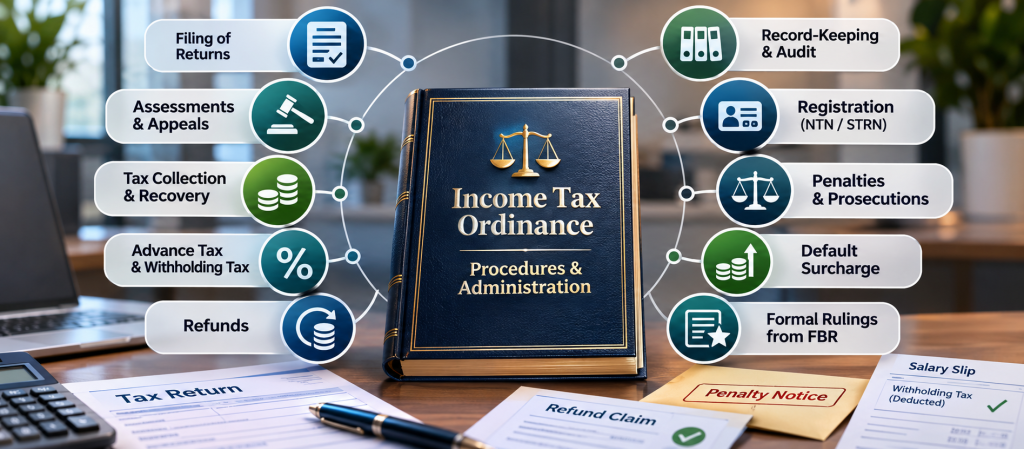
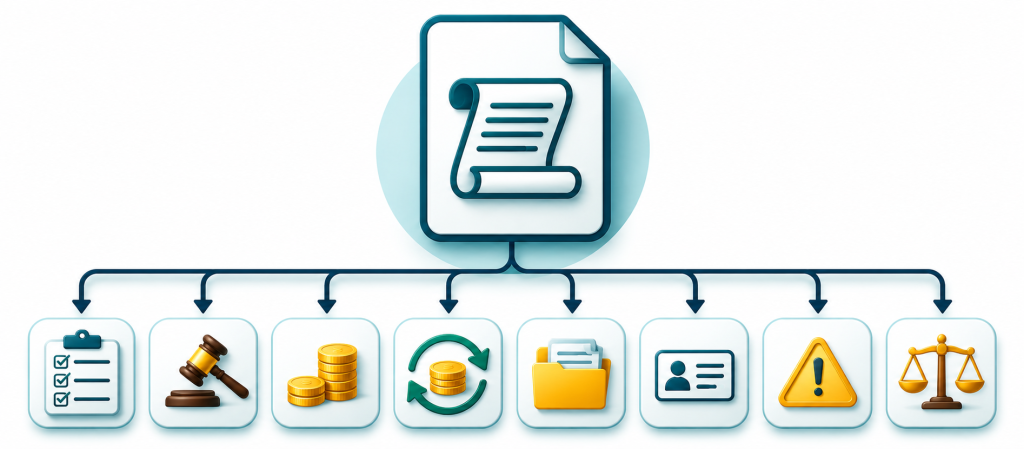
This is the Ordinance's biggest chapter, and it's the one most people actually interact with without realising it. It covers how returns are filed, how assessments and appeals work, how FBR collects and recovers unpaid tax, advance tax and withholding tax mechanics, refunds, record-keeping and audit requirements, registration, penalties, prosecutions, default surcharge, and how taxpayers can request formal rulings from FBR. Every withholding tax deduction on your salary slip, every penalty notice, every refund claim, all of it is procedurally governed here.
Chapter XI, who's actually in charge
This chapter sets up FBR's internal structure: the tax authorities themselves, their jurisdiction, their powers, and the various directorates-general that handle specific functions.
Chapter XII, the transitional advance tax rules you've definitely paid
This chapter authorises advance tax on a long list of everyday transactions: cash withdrawals, vehicle purchases and registration, electricity bills, property sales, and even air tickets. If you've ever noticed a small tax deduction on something that didn't feel like "income" at all, this chapter is usually why.
Chapter XIII, miscellaneous, but not unimportant
The final chapter covers FBR's rule-making power, the legal status of electronic records, and the repeal and transition provisions that moved authority to the Federal Board of Revenue in its current form.
And then, the Schedules
Beyond the thirteen chapters sit the Schedules, which carry the fine print that actually changes every year: specific tax rates, the detailed exemptions (the Second Schedule, which deserves, and gets, its own article), depreciation rules, and sector-specific computation methods. When a Finance Act "amends the Ordinance," it's very often one of these Schedules that's actually being rewritten.
Why this structure matters more than memorising it

You don't need to memorise thirteen chapters to run a compliant business. What's useful is knowing where to look. A withholding tax question almost always traces back to Chapter X or Chapter XII. A "why do I owe tax when I made a loss" question traces back to Chapter IX. A dispute over whether a payment is genuinely tax-exempt traces back to Chapter III and the Second Schedule. Once you know the map, FBR's letters and notices stop feeling like they're written in a foreign language, because you can place them.
This article reflects the structure of the Income Tax Ordinance 2001 as amended up to 2026. Individual sections and Schedules are revised frequently through Finance Acts and SROs, so always check the current FBR-published text for the exact wording applicable to your situation.