


For years, Pakistan’s creator economy ran on a quiet assumption: if the money came from YouTube, TikTok, or Instagram, FBR probably wasn’t watching too closely. That assumption is now officially retired.
Under Finance Act 2026 and a set of rules FBR finalized just weeks ago, content creators are being pulled into the tax net with a formula precise enough to calculate your minimum taxable income down to the view count.
If you earn from social media in any serious way, here’s exactly what changed, whether it applies to you, and what you need to do about it.

What actually changed, and when
Finance Act 2026 introduced a new withholding tax under Section 154B of the Income Tax Ordinance, effective July 1, 2026. Under this section, banks and payment processors must deduct 5% tax on any inward remittance or credit that originates from a social media platform, whether that’s YouTube AdSense, a TikTok Creator Fund payout, or a brand deal routed through Meta.
For creators on the Active Taxpayer List, this 5% is treated as a minimum tax, meaning it counts toward your final liability. For non-filers, the rate jumps to 10%. For non-residents, it’s a final tax, meaning it’s the end of the matter, with no adjustment either way.
This also quietly ended a perk a lot of creators didn’t realize they were enjoying: social media earnings used to ride along with Pakistan’s concessionary IT export tax regime, which carries a far lower rate.
Finance Act 2026 explicitly carved creators out of that benefit. You’re no longer treated like a software exporter. You’re treated like a media business.
Then, on September 23, 2026, FBR followed up by notifying the detailed compliance mechanics through three SROs: 1640(I)/2026, 1641(I)/2026 (covering resident creators), and 1642(I)/2026 (covering non-residents).
These replace the draft rules that had been circulating in various forms since April, and they’re the ones that actually matter now.

Are you affected? The 50,000-user rule, explained properly
A lot of what’s circulating online calls this a “50,000-subscriber rule.” That’s close, but not quite right, and the distinction matters.
FBR’s rule isn’t based on your subscriber or follower count sitting in your profile. It’s based on systemic and continuous interaction with users, measured as more than 50,000 users in a tax year, or 12,250 users in a single quarter.
In practice, this means the threshold is tracking ongoing audience engagement and monetized activity, not a static follower number you crossed once.
A creator with 80,000 followers who rarely posts and barely gets engagement could fall outside this test. A creator with a smaller but highly active, continuously monetized audience could fall inside it.
Cross that line, and your social media activity is treated as a business, with income computed under a specific formula rather than reported however you like.

How FBR calculates what you owe, even if you think you earned less
This is the part that catches creators off guard, and it’s worth understanding in detail.
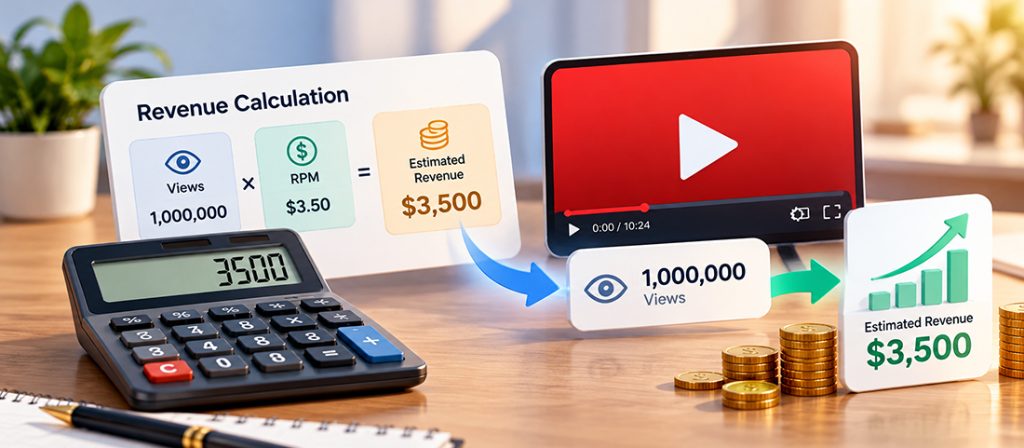
FBR set a benchmark of Rs 195 revenue per 1,000 views (RPM) on platforms like YouTube. Your taxable remuneration for the year is calculated as the higher of:
- The RPM benchmark applied to your average views per post, multiplied by your total posts for the year, or
- Your actual remuneration received, in cash or in kind.
In other words, FBR isn’t just taking your word for what you earned. It’s running your own view counts through a formula and comparing the result to what you declared.
If the formula number comes out higher than what you reported, that higher number becomes your minimum taxable income, unless you can satisfy the Commissioner with evidence that you genuinely earned less.
You’re allowed to deduct expenses, but only up to 30% of total revenue, not whatever you actually spent. So even a creator with unusually high production costs can’t deduct their way below that floor.
A worked example: say your channel pulled 2,000,000 views in a quarter. At Rs 195 per 1,000 views, that’s a benchmark revenue of Rs 390,000 for the quarter, regardless of what your AdSense dashboard actually shows. If your real payout that quarter was Rs 350,000, FBR’s formula still treats Rs 390,000 as your minimum, unless you can document otherwise. After the 30% expense cap, your floor for taxable income sits at roughly Rs 273,000 for that quarter alone.
What you actually need to do now
Here’s the practical checklist, stripped of the legal language:
Track your numbers properly. You need your own clean record of views per post, total posts per quarter, and actual payout amounts from every platform.
If your real earnings are below FBR’s RPM formula, the burden of proof is on you, and “I think I earned less” won’t hold up without evidence.
Expect automatic withholding on incoming payments. When AdSense, TikTok, or a brand payment lands in your bank account from abroad, your bank is now required to deduct 5% (or 10% if you’re not on the Active Taxpayer List) before you see the money. This happens whether or not you’ve filed anything. Being an active filer is the difference between that 5% counting toward your tax bill and it simply vanishing as a higher, final deduction.
File quarterly advance tax. Under Section 147 of the Income Tax Ordinance, this income now triggers quarterly advance tax obligations, not just an annual filing.
Declare it in the right place. Your annual income tax return now has a specific section for this kind of income. Lumping it in elsewhere, or leaving it out because “the bank already deducted something,” is exactly the kind of gap that invites a Commissioner’s review and a recovery notice for the shortfall.
Get on the Active Taxpayer List if you’re earning seriously. The gap between the 5% filer rate and the 10% non-filer rate, on top of losing the ability to adjust that deduction against your final liability, makes non-filer status a genuinely expensive choice for anyone making real money from content.

The bottom line for Pakistani creators
The era of social media income existing in a tax grey zone is over, and it ended with more precision than most creators expected.
FBR isn’t just asking you to declare your earnings; it’s built a formula to check them against your own view counts. If you’re creating content as a side hustle with a small, inconsistent audience, this likely doesn’t touch you yet.
If you’re running it as a real income stream with a large, continuously engaged audience, the smartest move is to start keeping proper records now, before a formula-generated number lands on your desk with FBR’s math behind it instead of yours.
This article reflects Section 154B of the Income Tax Ordinance 2001 as introduced by Finance Act 2026, and SROs 1640(I)/2026, 1641(I)/2026, and 1642(I)/2026 notified by FBR on September 23, 2026, current as of October 2026. FBR periodically revises the RPM benchmark and procedural details through further notifications, so it’s worth confirming the current figures for your specific situation.
References:
FBR: Draft SRO 545(I)/2026 (non-resident social media income procedure)
Business Recorder: FBR notifies rules to tax social media income